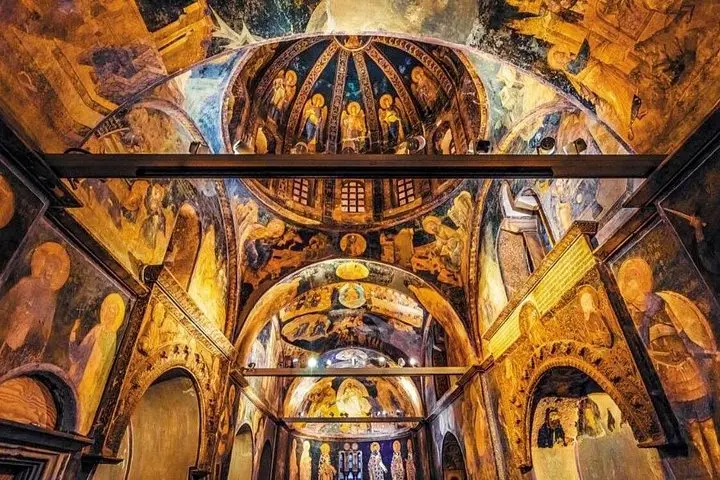
Chora—known today as Kariye—stands apart from Istanbul's largest imperial monuments. Its scale is more intimate, but its visual program is extraordinarily ambitious. Gold mosaics, expressive frescoes and carefully shaped spaces guide the visitor through ancestry, incarnation, death and resurrection.
The images become far more meaningful when they are read in sequence. A private guide can connect the scenes, inscriptions and architectural spaces instead of treating the building as a collection of attractive photographs.
Why the building is called Chora
The historic name relates to the building's location beyond an earlier circuit of Constantinople's walls. Later interpretation also connected the word with images of Christ and the Virgin as the dwelling place of the living and the infinite. The name therefore opens both a geographical and symbolic path into the monument.
A late Byzantine masterpiece
Much of the celebrated decoration belongs to the early fourteenth century and is associated with Theodore Metochites, a statesman and scholar of the Byzantine court. The program reflects the refinement of the Palaiologan period: elegant movement, complex storytelling and an unusually human sense of emotion.
The mosaics: a story in sequence
The narthex mosaics unfold episodes connected with Christ and the Virgin. Family relationships, journeys, gestures and architectural settings link one scene to another. Many subjects come from traditions unfamiliar to first-time visitors, which is why labels alone rarely provide enough context.
A knowledgeable guide helps you notice how figures are grouped, how direction and movement lead the eye, and why specific scenes appear where they do.
The funerary chapel and the Anastasis
The frescoes of the funerary chapel shift the mood. The celebrated Anastasis presents Christ drawing Adam and Eve from their tombs—a dynamic image of resurrection and victory over death. Nearby compositions develop ideas of judgment, salvation and remembrance within a space designed for burial and prayer.
This chapel is often the emotional high point of the visit. Understanding its function makes the imagery more powerful.
What a specialist guide adds
- A clear sequence through the building's visual program
- Identification of figures, inscriptions and less familiar episodes
- Connections between image placement, architecture and ritual use
- Historical context for Theodore Metochites and late Byzantine Constantinople
- Comparison with Hagia Sophia and other Byzantine monuments
How to plan the visit
Chora lies away from Sultanahmet's main walking route. A private vehicle is usually the most efficient choice when combining it with the Theodosian Walls or other Byzantine sites. The final plan should always be based on the official access conditions, restoration status and opening arrangements for your date.
Who is this experience for?
Chora is especially rewarding for travelers interested in art history, Christian heritage, Byzantine studies, architecture and the relationship between sacred images and space. It also works beautifully for returning visitors who have already seen Istanbul's most famous monuments.
Know before you go
- Opening hours, worship periods and visitor access can change.
- Dress requirements may apply because Kariye functions as a mosque.
- Admission is separate unless your confirmation states otherwise.
- Photography and access to individual areas follow current official rules.
- Security procedures cannot be bypassed.
Look beyond the gold.
Explore Chora with the historical and artistic context needed to understand one of Istanbul's most important Byzantine monuments.
View the private Chora & Constantinople tour →